
Most funding articles copy Crunchbase and call it research. This page does something different: I built a dataset of 30 companion chatbot companies, funded, bootstrapped, dead, and opaque, and computed the statistics myself. The question I actually wanted answered: does allowing adult content make a companion chatbot startup harder to fund? I went in treating that as a hypothesis, not a conclusion. What came out is one of the strangest capital allocation patterns I’ve seen in any market I’ve researched.
The short answer: companion chatbot companies have disclosed roughly $415.6 million in funding (excluding one $1.5 billion edge case), and 99.25% of it went to SFW and wellness platforms. The entire NSFW-friendly cohort’s disclosed institutional capital is $3.1 million, less than 1%, while generating some of the category’s best revenue: Candy AI claims $25M+ ARR on zero dollars raised. The gap is real. This page measures it; my research note explores why it may exist.
Methodology up front, because this page is only as honest as its rules: everything below counts disclosed funding only, undisclosed is treated as unknown rather than zero, one company (Inflection) is tracked but excluded from headline sums as an edge case, and every number names its source. The full dataset behind this page, every company, round, investor, and outcome, with per-row sources, is downloadable as a PDF so you can check my work. Sources at the bottom.
Table of contents · 14 sections
- AI Companion Funding: Editor’s Choice
- The dataset behind this page
- How big is the companion chatbot market?
- The adoption behind the money
- What Google Trends shows
- How much VC funding has the companion chatbot industry raised?
- Who institutional money actually backs
- The NSFW funding gap: testing the hypothesis
- The counter-explanation: they may not need it
- Three funding timelines
- What happened to the money
- Verdict: what the data actually says
- Conclusion
- FAQs
AI Companion Funding: Editor’s Choice
- →Companion chatbot companies have disclosed ~$415.6 million in total funding across my 30-company dataset (excluding one $1.5B edge case).
- →99.25% of disclosed funding went to SFW and wellness platforms; the NSFW-friendly cohort raised $3.1 million.
- →The top three raises (Character.AI, Embodied, Chai) account for 76.5% of all non-edge-case funding.
- →Median disclosed raise: $10.5M for SFW companies vs $1M for NSFW-friendly ones.
- →Every tier-one VC round I could find (a16z, Khosla, Lightspeed, General Catalyst, USV, Coatue) sits on the SFW side.
- →The disconnect: Candy AI claims $25M+ ARR on $0 raised; Chai runs a $70M ARR business with no traditional VC.
- →Exactly half the companies tracked (15 of 30) have no disclosed funding at all, and they include some of the biggest traffic in the category.
The dataset behind this page
Every computed number below comes from a dataset I built for this research: 30 companion chatbot companies, funded, bootstrapped, parent-owned, and dead, with per-company funding, rounds, investors, cohort tags, traction evidence, outcomes, and a per-row primary source, plus a 19-round investor-level table. The whole thing is downloadable as a PDF: Table A covers the 15 companies with disclosed funding, Table B the 15 without (and what funds them instead), Table C the round-by-round investor map, and the two-cohort test that anchors this page. It’s published under CC BY 4.0, so cite it, quote it, or check my work against it. The narrative version of this research, the story of where the money went, told properly, lives in my research notes.
How big is the companion chatbot market?
Funding only makes sense against market size, and here the honest finding is that the analysts disagree spectacularly.
1. Published estimates put the AI companion market anywhere from $4.2 billion to $37 billion in 2025, heading toward $100B-$550B over the next decade.
Honesty ladder first: these ranges disagree because “AI companion” has no settled definition. Grand View pegs the broad market at $36.79B in 2025 growing 31% annually toward $317.96B by 2033; GM Insights sizes companion apps at $14.1B in 2024 toward $115.3B by 2034; the narrowest app-only definition (Research and Markets) says $4.24B in 2025. Every one of these is a forecast of a broadly defined future, so this page reports the range, not a false precision.
2. The reality check: observed consumer spending inside dedicated companion apps ran around $120 million in 2025, against forecasts in the tens of billions.
The most important market-size fact is the gap between models and receipts: app-store intelligence tracked roughly $120M of actual in-app companion spending in 2025, two orders of magnitude below the analyst figures. Much real revenue hides outside app stores, on the web, where adult platforms live precisely to escape app-store rules, which means the truest market number is unknowable, and web-first NSFW revenue (the Candy AIs of the world) is systematically missing from every official estimate. Note the rhyme with this page’s funding thesis: the adult side is undercounted in the market data for the same reason it’s absent from the funding data.
3. The segment closest to this site: the AI girlfriend app market is sized at $2.32 billion in 2025, reaching $2.91 billion in 2026, about 25.5% annual growth.
A rare girlfriend-specific estimate, methodology not public, so treat it as directional. Even at face value it implies the romantic segment alone out-earns the narrowest whole-category estimates from two years earlier, which matches what my testing wallet keeps discovering: this end of the market is where the paying happens. My deep numbers on it live in my AI girlfriend statistics.
The adoption behind the money
The demand side, briefly, because it’s the context every funding decision on this page is reacting to. The full picture lives in my AI companion statistics.
4. 72% of US teens have used an AI companion, and 52% use one regularly.
The adoption statistic that reframes the entire category from niche to mainstream, and, for investors, the one that explains both the appetite (a generational behavior shift) and the anxiety (it’s minors, which is exactly why 2026’s funded startups all lead with safety positioning).
5. Roughly 1 in 5 US adults has chatted with an AI romantic partner, and “companionship and therapy” ranked as the #1 use of generative AI in 2025.
Companionship isn’t a side effect of the AI boom; by usage ranking, it’s the main event. Hold this against the funding map: the most common use of generative AI is the one tier-one capital funds only in de-romanced form.
6. The category’s engagement is what usage-based businesses dream of: Character.AI sessions average around half an hour, and Chai reports 2 million daily users at 90-minute average sessions.
Session lengths that embarrass social media are the reason this category keeps attracting capital despite its risks: whatever else these companions are, they are the stickiest consumer AI products yet measured.
What Google Trends shows
The search-interest curve is the demand story in one picture: essentially zero before 2023, ignition the moment ChatGPT normalized talking to machines, and a climb that hasn’t stopped since.
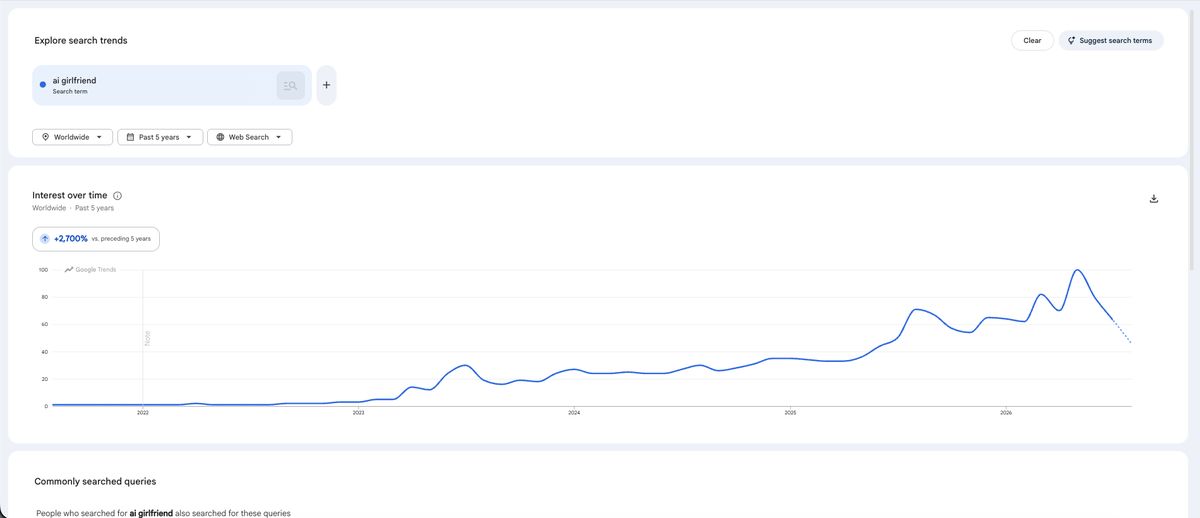
7. Worldwide search interest for “ai girlfriend” is up +2,700% versus the preceding five years, hitting its all-time peak in 2026.
The shape tells the story better than the multiplier: the term barely existed before 2023, ignited in the months after ChatGPT’s launch, plateaued through 2024 at roughly a third of today’s interest, then doubled across 2025 and 2026 to touch the 100 mark, the all-time high, this year. Note the sequencing against the funding data above: search demand went vertical in 2023, while the institutional funding wave arrived in 2025-26, two years behind the users, and only for the de-romanced versions of what they were searching for.
How much VC funding has the companion chatbot industry raised?
The totals first, then the shape of them, which turns out to matter more.
8. Companion chatbot companies have disclosed ~$415.6 million in institutional funding across 30 tracked companies, 15 of which have raised at all.
The methodology sentence that most funding articles skip: this counts publicly disclosed rounds only, treats undisclosed as unknown rather than zero, and excludes one giant edge case covered below. Real capital in this category is likely higher, but this is what anyone can actually verify, and the pattern inside it is the story.
9. The average disclosed total is $121.3 million; the median is $9.25 million. That 13x spread is the concentration statistic.
When an average runs thirteen times the median, a handful of giants are carrying the entire number. The typical funded company in this category raised well under ten million dollars; the category’s headline figure is really three or four stories wearing one statistic.
10. The top three raises, Character.AI ($193M), Embodied ($70M+), and Chai ($55M), hold 76.5% of all non-edge-case funding.
Three companies, three-quarters of the money, and notably, three completely different fates: one sold its founders to Google, one shut down and bricked its robots, and one is a profitable business funded by its GPU vendor. Concentration says nothing about outcomes here, which is its own finding.
11. The edge case: Inflection AI raised $1.525 billion for its companion chatbot Pi, more than the rest of the category combined, times three.
Honesty ladder: I track Inflection but exclude it from headline sums, because Pi was a general companion chatbot from a frontier lab, not a character or relationship platform, and its capital story ended differently too: a ~$650M Microsoft licensing-and-acquihire deal in March 2024, after which Pi was effectively sunset. Include it and the category total balloons to $1.94 billion while describing the market worse.
12. Exactly 15 of the 30 companies tracked, half the dataset, have no disclosed funding of any kind.
And this isn’t the obscure half: it includes several of the highest-traffic platforms in the category. In most markets, no-funding correlates with no-traction. In this one, the unfunded half contains much of the traction, which is the anomaly the rest of this page unpacks.
Who institutional money actually backs
The 2025 and 2026 rounds are the most revealing part of the dataset, because they show what investors fund now, with full knowledge of what this category is.
13. The 2025-26 funded wave: five companion startups raised a combined $66.5M+: Tolan ($30M), Status AI ($17M), CODE27 ($10M+), Shapes ($8M), and Charms ($1.5M).
A genuine reopening of the category after the post-Character.AI chill, with marquee names attached: Khosla led Tolan’s Series A, Lightspeed led Shapes’ seed, and General Catalyst and Union Square Ventures backed Status. Companion chatbots are very much fundable in 2026. The question is which kind.
14. The pattern across all five: every newly funded companion startup is structurally distanced from romance.
Tolan’s aliens are programmed to refuse romantic and sexual interactions entirely. Shapes markets itself as the antidote to “AI psychosis” and one-on-one attachment. Status turns characters into a gamified social world. CODE27 sells licensed anime IP in hardware. Charms builds a creator economy. Five rounds, five different mechanisms for being a companion company that is definitely not an AI girlfriend company. Whatever the reason, that positioning is consistent across every newly funded company in this group.
15. Every tier-one venture round in the dataset sits in the SFW or wellness cohort: a16z, Khosla Ventures, Lightspeed, General Catalyst, Union Square Ventures, Y Combinator, Coatue.
I built a separate investor-level table for this page, and the cleanest way to state its finding: I could not find a single tier-one venture firm leading a disclosed round in an explicitly NSFW companion company. Not one, across the entire history of the category. The closest exceptions are tiny: an accelerator check into Dippy and roughly $1M of angel money into SpicyChat.
16. The transparency tell: SFW rounds come with proudly named leads; the category’s edgier raises hide their investors.
Tolan’s announcement names Khosla and Keith Rabois in the first paragraph. Shapes names Lightspeed. Meanwhile CODE27’s $10M arrives from unnamed “leading global venture funds,” and on the adult side, disclosure simply doesn’t happen at all. In this category, whether investors want their name attached is itself a data point about where the reputational line sits.
The NSFW funding gap: testing the hypothesis
Now the two-cohort test I built the dataset for: mainstream and wellness platforms on one side, NSFW-friendly platforms (Candy AI, SpicyChat, CrushOn, JanitorAI, Muah, Nomi, Kindroid, and peers) on the other.
17. Disclosed funding by cohort: SFW and wellness platforms $412.5M; NSFW-friendly platforms $3.1M. That is 99.25% against 0.75%.
This is the headline test of the hypothesis, and the gap is not subtle. For every dollar of disclosed institutional capital that has reached an adult-friendly companion platform, about $133 went to the safe side of the category.
18. 13 SFW-cohort companies have disclosed at least one round. On the NSFW side: two, SpicyChat (~$1M of angel money) and Dippy ($2.1M from an accelerator).
And note what those two exceptions are: not institutional venture rounds with named funds, but the smallest checks in startup finance. The largest disclosed NSFW-cohort total ($2.1M) is 92 times smaller than the largest SFW one ($193M).
19. Median disclosed raise: $10.5M in the SFW cohort vs $1M in the NSFW cohort.
Medians strip out the giants, and the gap survives: even a typical funded SFW companion company raises ten times what the rare funded adult one does. Whatever explains this pattern, it isn’t Character.AI skewing the math.
20. The traffic-vs-capital disconnect: Candy AI alone draws an estimated 15-25 million monthly visits, top-five in the category, on 0% of its funding.
And Candy is not the outlier; it’s the pattern. JanitorAI operates what testers describe as the largest character library in the unfiltered space with zero funding disclosures; SEMrush measured roughly 138 million visits in December 2025, and Similarweb ranked it inside the top 250 websites globally by mid-2026. Add CrushOn, Muah, Nomi, and Kindroid, all undisclosed, and a very large share of real category demand runs on platforms that institutional capital has, on paper, never touched.
21. The revenue disconnect is starker: the NSFW side’s flagship claims more ARR than the funded side’s flagship earns.
Candy AI’s claimed $25M+ ARR (traffic-based estimates run $50-120M) was reached on zero disclosed dollars. Character.AI, with $193M raised, was reported around $32M in 2024 revenue, rising to roughly $50M in 2025 (Business of Apps; Sacra’s equity research tracked a $30M run rate mid-2025). Capital and cash flow are living on opposite sides of this market, which is the strangest single fact in the dataset.
The counter-explanation: they may not need it
Here’s where honest research diverges from a convenient narrative. “VCs reject adult AI” is only one reading of the gap. The other: adult AI never asked.
22. Chai runs a $70M ARR business whose $55M in capital came from its GPU vendor, CoreWeave, not from venture firms.
The most instructive capital structure in the category: a $2M pre-seed in June 2023, then strategic rounds from CoreWeave at a $450M valuation, capital from the company selling Chai its compute. Chai proves you can build one of the category’s biggest revenue businesses while never taking a traditional VC dollar, and that alternatives to Sand Hill Road exist for companies that want growth capital without its conditions.
23. Of the 15 companies with no disclosed funding, the dataset finds three distinct models: revenue-funded, parent-funded, and deliberately opaque.
Half the dataset has no disclosed funding, but the reasons split three ways:
- Revenue-funded (apparent): Candy AI, JanitorAI, Kindroid, Nomi, and peers, where subscriptions appear to carry the business outright.
- Parent-funded: Talkie, whose capital flows through its Chinese AI-lab parent MiniMax (roughly $1.15B raised privately before its January 2026 Hong Kong IPO), and EVA AI, operated inside the private dating conglomerate Social Discovery Group.
- Opaque: CrushOn, Muah, and several girlfriend apps whose corporate structure resists mapping entirely.
“Unfunded” turns out to mean three different things, and only one of them means what the hypothesis assumed.
24. The ownership-opacity stat, from my own testing: adult companion platforms bill under names like “Dream AI” and “NDAI.CC”, and their corporate parents are barely traceable.
I pay for and test these apps myself, and the biller names on my statements are deliberately quiet: DreamGF charges as “Dream AI” and GirlfriendGPT as “NDAI.CC”, findings from my own subscriptions. Candy AI’s operator EverAI has been linked in reporting to a Malta-based structure and the Octavian Holding group. This matters for funding data: an adult platform could hold private capital invisibly, because nothing about these structures is built for disclosure. Which is exactly why this page counts disclosed funding only, and says so.
25. The economics explanation: category analyses put gross margins on paid adult-companion subscriptions near 90%, which makes venture capital optional.
A subscription business converting at adult-content prices with 90% gross margins funds its own growth. On those numbers, the absence of VC on the adult side stops looking like rejection and starts looking like founders who never needed to dilute, and who benefit from staying private in a category where investor scrutiny cuts both ways.
Three funding timelines
Three companies, three completely different relationships between capital and content policy. Per my rule for this page: what follows observes timing; it does not claim causation.
26. Character.AI: $43M seed (Dec 2021) → $150M Series A at $1B (Mar 2023, a16z) → Google licensing deal at $2.5B (Aug 2024) that bought out investors and took the founders back to Google.
The category’s defining capital story: the fastest unicorn run in consumer AI, then the “reverse acquihire” that sent Noam Shazeer, Daniel De Freitas, and ~30 researchers to Google while investors exited at 2.5x. Worth observing, carefully: Character.AI prohibited explicit content from its earliest days, before, during, and after every round. Its investor-friendly positioning didn’t follow the money; it preceded it, which is at least consistent with positioning being part of what made the money possible.
27. Replika, the category’s pioneer, raised just $11 million across three rounds, and its romantic features have whiplashed with its regulatory life, not its funding.
Founded in 2015 (as Luka), backed early by Y Combinator, and never venture-scaled: Character.AI raised 17 times more in a single round than Replika has in a decade. Its adult-content arc ran on a different axis entirely: erotic roleplay removed in February 2023 after Italy’s regulator intervened, partially restored for legacy users after user outcry. Replika is the nuance case: modest capital, shifting content policy, and proof the two don’t move in lockstep.
28. Candy AI is the bootstrapped giant: $0 disclosed funding, $25M+ claimed ARR, top-five category traffic, and a reported M&A offer in 2025.
The inverse of Character.AI on every axis: no named investors, no disclosed rounds, explicit content at the core of the product, and a business that apparently grew to eight figures on its own cash flow inside two years. If the funding gap has a poster child on each side, these two companies are it.
What happened to the money
Funding data means little without outcomes, so the dataset tracks the dead as carefully as the living.
29. The biggest write-off: Embodied raised roughly $69M from Intel Capital, Amazon’s Alexa Fund, Sony, and Toyota, and shut down in December 2024 when a funding round collapsed, initially bricking children’s Moxie robots.
The category’s hardest lesson in what funded doesn’t mean: a corporate-VC-backed, safety-positioned, kids-wellness companion, the most fundable profile imaginable, whose $799 robots stopped working when the money did. A community rescue effort later restored partial functionality. Meanwhile several unfunded adult platforms from the same era are still running profitably.
30. The quieter failures: Dot shut down in October 2025, Soulmate was sold and closed in 2023, and Forever Voices collapsed after its founder’s 2023 arrest.
Three different failure modes: Dot’s founders split over vision with roughly $3.7M raised; Soulmate’s owner sold the company and gave users one week to say goodbye to companions some genuinely grieved; Forever Voices (maker of the CarynAI girlfriend bot) simply imploded. Shutdown risk, notably, runs across both cohorts, funded and not.
31. And the largest companion bet no longer exists as one: Inflection’s $1.525B-funded Pi was effectively sunset after Microsoft’s ~$650M licensing-and-acquihire in March 2024.
The edge case’s ending completes the outcomes picture: of the three biggest capital events in companionship-adjacent AI, two ended with Big Tech extracting the founders and models (Inflection to Microsoft, Character.AI to Google) rather than the products winning their markets. Investors did fine; the companions themselves became licensing collateral.
Verdict: what the data actually says
I went in with a hypothesis and no conclusion. Here is what the dataset supports.
32. The verdict: institutional capital and adult revenue occupy remarkably separate halves of the companion chatbot market.
Three conclusions, each carried by its own numbers. First, the money is top-heavy: a few enormous rounds dominate a median raise under ten million, so the category’s headline total describes a handful of companies. Second, the institutional side has a hard content line: 99.25% of disclosed capital sits with SFW and wellness platforms, no tier-one firm appears in any adult-companion round, and 2026’s newly funded startups are aggressively de-romanced by design. Third, the adult side largely runs without disclosed capital: subscription businesses, quiet billing entities, and companies like Candy AI that report a claimed $25M+ ARR with $0 raised on the record. That division is what the dataset demonstrates. Why it exists, whether it is a wall one side built or a border both sides keep, is a question these numbers cannot answer by themselves; my interpretation lives in my research note on the adult-content funding line.
I test the products this money did and didn’t build.
I pay for and test both kinds of app on my own accounts, funded and bootstrapped alike. For my read on how funding shapes the products, start with the story behind the funding divide; the full market data is in my AI girlfriend statistics, and the hands-on reviews live on my homepage.
Conclusion
So, the AI companion funding statistics of 2026: roughly $415.6 million disclosed across the category, three companies holding three-quarters of it, a median raise under ten million, and a 99.25% to 0.75% split between the safe side and the adult side, while the adult side quietly generates revenue the funded side envies.
My read as a data researcher: this is the rare market where following the money misleads you. The funding map says the category belongs to wellness aliens and group-chat characters; the traffic map says a very large share of actual usage lives on platforms no institutional investor will name in a press release. Both maps are accurate. They’re just maps of different things, reputation and demand, and in this category they point in opposite directions. What that pattern means for the products, and why I think the divide holds, is the subject of what I learned following the money.
FAQs
How much venture funding have AI companion companies raised?
Roughly $415.6 million in disclosed funding across the 30 companies in my dataset, excluding Inflection AI’s $1.525 billion as an edge case. The total is highly concentrated: Character.AI ($193M), Embodied ($70M+), and Chai ($55M) account for 76.5% of it, and the median disclosed raise is just $9.25 million.
Which AI companion company has raised the most money?
Character.AI, with $193 million ($43M seed in 2021 plus a $150M Series A led by Andreessen Horowitz in 2023 at a $1 billion valuation). In August 2024, Google paid for a licensing deal valuing it at $2.5 billion, bought out its investors, and hired back its founders. Counting companion-adjacent products, Inflection AI raised $1.525 billion for Pi before a Microsoft acquihire ended it.
Do venture capital firms fund NSFW AI companion apps?
Almost never, on the record. In my dataset, the entire NSFW-friendly cohort’s disclosed institutional funding is $3.1 million (an angel seed into SpicyChat and an accelerator check into Dippy), against $412.5 million for SFW platforms, and no tier-one venture firm appears in any disclosed adult-companion round. Undisclosed private capital may exist, but nothing about these companies’ structures is built for disclosure.
Why don’t VCs invest in adult AI companions?
The dataset shows the gap, not the reason. Two plausible explanations: reputational caution, since firms avoid attaching their names to explicit content and every newly funded companion startup in 2025-26 is positioned away from romance, and economics, since some adult platforms appear able to fund themselves from subscriptions, with Candy AI reporting a claimed $25M+ ARR on $0 raised. My full interpretation is in the research note linked above.
Who are the biggest investors in AI companion startups?
Andreessen Horowitz (Character.AI’s $150M Series A), Khosla Ventures (led Tolan’s $20M Series A), Lightspeed (led Shapes’ seed), General Catalyst and Union Square Ventures (Status AI), and CoreWeave, the GPU provider whose strategic investments in Chai are the category’s largest non-VC capital. Google and Microsoft matter most of all, though, as the acquirers who ended the two biggest funding stories.
Sources
- The AI Companion Funding Dataset v1.0 (this page’s underlying data: 30 companies, per-row sources). Download the PDF
- BusinessWire: Character.AI $150M Series A announcement (March 2023). businesswire.com
- CNBC: Character.AI valued at $1 billion after a16z round. cnbc.com
- Contrary Research: Character.AI company profile (Google deal, Replika funding history). research.contrary.com
- Chai Research: Strategic Round II announcement (revenue, DAU, CoreWeave). chai-research.com
- Wikipedia: Chai AI (funding timeline, valuation). en.wikipedia.org
- Latka: EverAI revenue and funding profile (Candy AI operator, $0 raised). getlatka.com
- GeekWire: Tolan raises $20M Series A (Khosla Ventures). geekwire.com
- TechCrunch: Shapes emerges with $8M seed (Lightspeed). techcrunch.com
- TechCrunch: Status AI announces $17M seed and Series A. techcrunch.com
- GlobeNewswire: CODE27 secures over $10M for character companion hardware. finance.yahoo.com
- Chainwire: Charms $1.5M pre-seed announcement. chainwire.org
- TechCrunch: Dot AI companion app is shutting down. techcrunch.com
- Business of Apps: character.ai revenue and usage statistics (~$50M 2025 revenue). businessofapps.com
- Sacra: Character.AI equity research (revenue run rate). sacra.com
- CB Insights: Embodied and MiniMax funding profiles. cbinsights.com
- SEMrush: janitorai.com traffic statistics. semrush.com
- Grand View Research: AI Companion Market Report (market size, 2025-2033). grandviewresearch.com
- GM Insights: AI Companion App Market (app-market sizing). gminsights.com
- Common Sense Media: Teen AI companion usage survey (July 2025).
- Prinsessa: AI companion market analysis (observed app spending vs forecasts; AI girlfriend segment sizing). prinsessa.com
- Google Trends: search interest for AI companion terms. trends.google.com
- TechStartups: Character.AI funding total and Google deal context. techstartups.com